
Takeaways
• Student dormitories have become Hong Kong’s fastest-growing real estate play, offering rare stability amid a slump in offices and retail space
• Government efforts to brand the financial hub as a regional center for higher education are fueling demand for student accommodation, creating a new revenue channel and stoking investor appetite.
• The city recorded HK$3.2 billion worth of transactions for dorm purposes in the first nine months this year, almost double the amount from the same period last year, with investors attracted to the sector’s strong demand and cash flow.
It’s what private equity giants tout at property summits and agents pitch to clients – not shopping malls, not data centers, but student dormitories.
The assets have become Hong Kong’s fastest-growing real estate play, offering rare stability amid a slump in offices and retail space. Local developers, universities, and global funds are piling in, betting on a steady stream of mainland Chinese students.
Government efforts to brand the financial hub as a regional center for higher education are fueling demand for student accommodation, creating a new revenue channel and stoking investor appetite for this niche asset class.
“It’s the sector that everyone is most enthusiastic about,” said Reeves Yan, head of capital markets for Hong Kong at CBRE Group Inc. “There’s a huge shortage of student accommodation. Newly built ones get rented out almost immediately.”
The strong demand and cash flow – tenants tend to pay rent for a full year – have attracted all sorts of investors including global funds and foreign investors, he added.
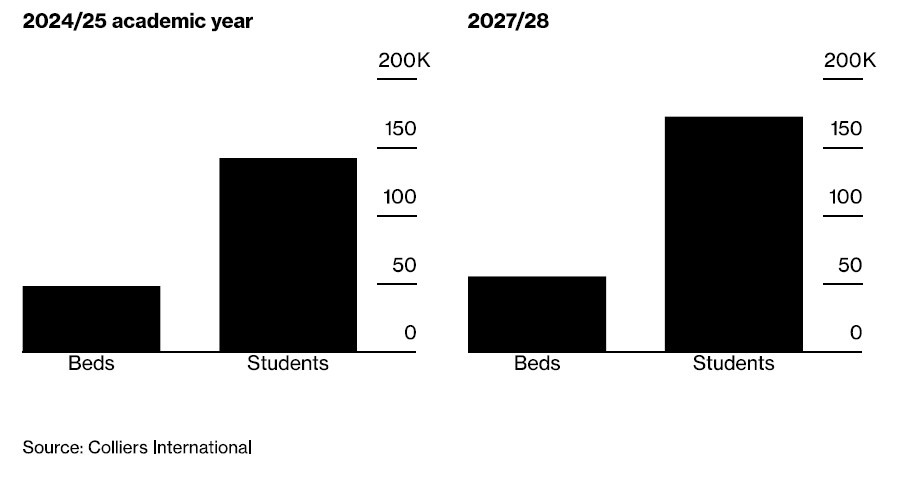
Estimated shortfall to grow to 120,000 beds in 2027
At a recent conference in Singapore, Pak Man Yuen, managing director for real estate at Blackstone Inc., called go the prospect of converting hotels into student housing or other residential uses “one of the most interesting opportunities” in Hong Kong. He highlighted struggling hotels, where one can pursue multiple strategies, including student housing and multi-family dwellings.
The city recorded HK$3.2 billion ($412 million) worth of transactions for dorm purposes in the first nine months this year, almost double the amount from the same period last year, data from Colliers International show. It is also going more mainstream – it accounts for 15% of the total number of property investments valued at HK$100 million or more so far this year, compared with 7% in 2024.

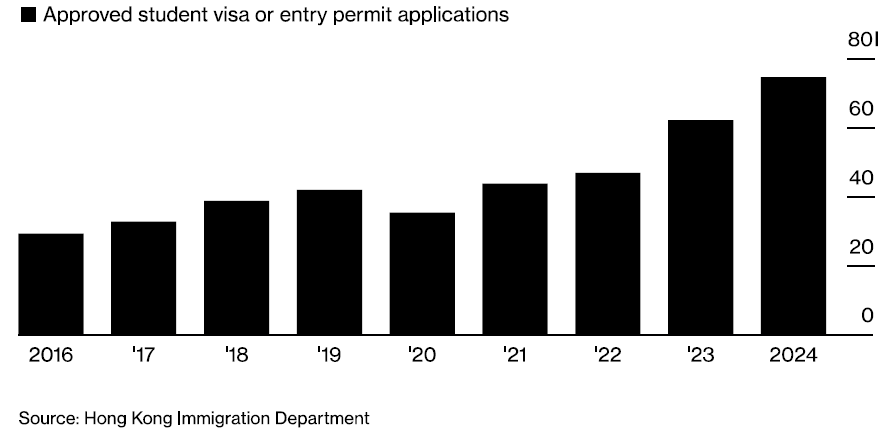
Hong Kong has seen a surge in non-local students, mostly from mainland China, over the past few years. Approved student visas more than doubled to 74,466 in 2024 from 2020, government data show. By the 2027/28 academic year, the city will face a shortfall of about 120,000 student beds, according to estimates from Colliers.
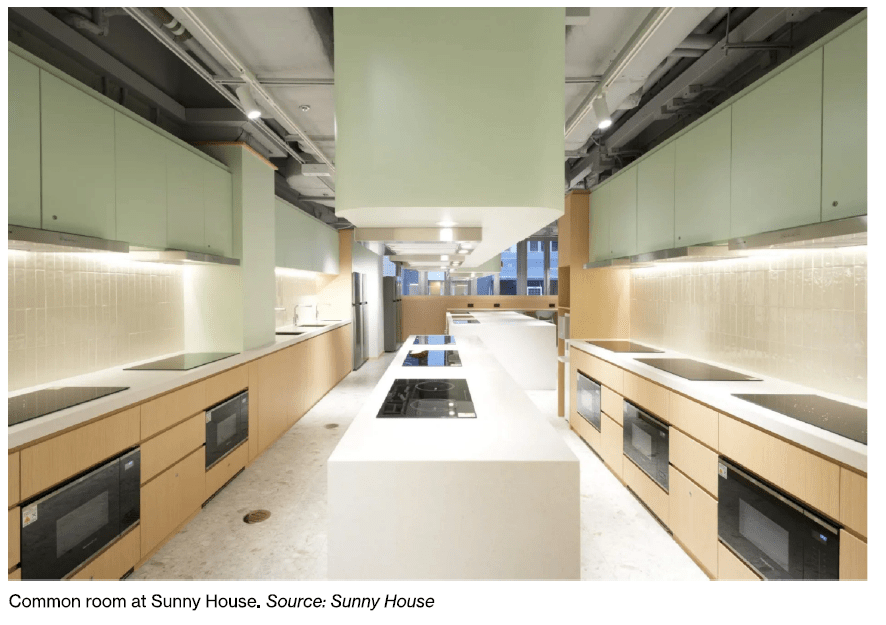
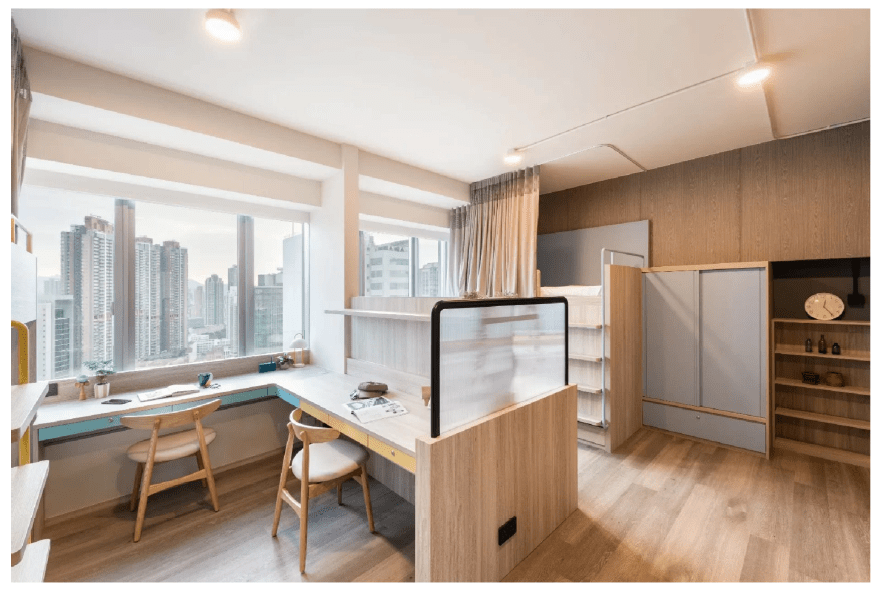
“There is very strong demand for dorms but a lot of accommodation available to students is not up to standard,” said Nick Tang, chief executive director at Wang On Properties Ltd., who sees the gap in the market as an opportunity. The local developer has partnered with Angelo Gordon & Co. to turn a hotel into a 720-unit student rental housing property called Sunny House targeting students, which started operating last year. It has an occupancy of 98%, said Tang. The partnership purchased another hotel in July to add to their portfolio in the sector.
Angelo Gordon, AEW Capital Management and PIM Real Estate are institutional investors involved in student housing projects worth HK$4.6 billion since 2021, according to Colliers
Investor enthusiasm is being fueled by Hong Kong’s push to position itself as a higher-education hub for mainland Chinese students. In September, the government said it would raise the cap on non-local undergraduate enrollment at public universities to 50% from 40%. It has also earmarked land in the city’s flagship tech development, the Northern Metropolis, for a planned “university town” aimed at attracting leading institutions and research centers from mainland China and overseas.
Visa and immigration restrictions in the US may also boost demand for Hong Kong’s universities. “Some places are becoming less welcoming toward newcomers,” making Hong Kong a more competitive destination, said Gordon Tse, senior director at Midland Holdings, which offers immigration and student visa consulting services. “Hong Kong happens to be trying to revive its status as an international city after Covid lockdown through different ways including developing the education industry”
The industry has a lot of room for growth compared with long-established players in the higher-education sector in other parts of the world that have mature infrastructure. In some jurisdictions, including the UK and Australia, student accommodation has become a very mature sector for institutional investors, with some portfolios being listed as real estate investment trusts, according to Kathy Lee, head of research at Colliers.
Hong Kong’s dormitory development remains far behind, with a limited supply of professionally managed student housing, she said.
The number of student visas approved continues to rise in Hong Kong
To be sure, Hong Kong doesn’t rank high in investors’ priorities given its wider real estate slump and better returns elsewhere in Asia. One US-based fund manager who passed on investing in the sector said places like Japan still boast more liquidity and opportunities.
Hong Kong property values are still comparatively elevated. The yield for student housing is about 5%, close to the current borrowing rate, so buyers are only interested if they can find a heavily discounted deal, said Tom Ko, head of capital markets at Cushman & Wakefield Hong Kong.
In comparison, student dorm yields also generate about 5-6% yield in places like the UK and Australia, according to Lee.
Funding is another issue. Hong Kong is listed by investors as the most challenging major market to obtain debt financing for real estate investment, according to a survey by CBRE Group Inc.
The city’s commercial market has been in a downturn for the past few years. Values of office units and retail space have slumped by 50% and 42% respectively from their 2018 highs, according to government data.
With the lackluster wider market, student housing appears a safe bet in Hong Kong. “It offers stable and predictable income,” said Tang from Wang On.
– With assistance from Low De Wei
Original URL: Click Here